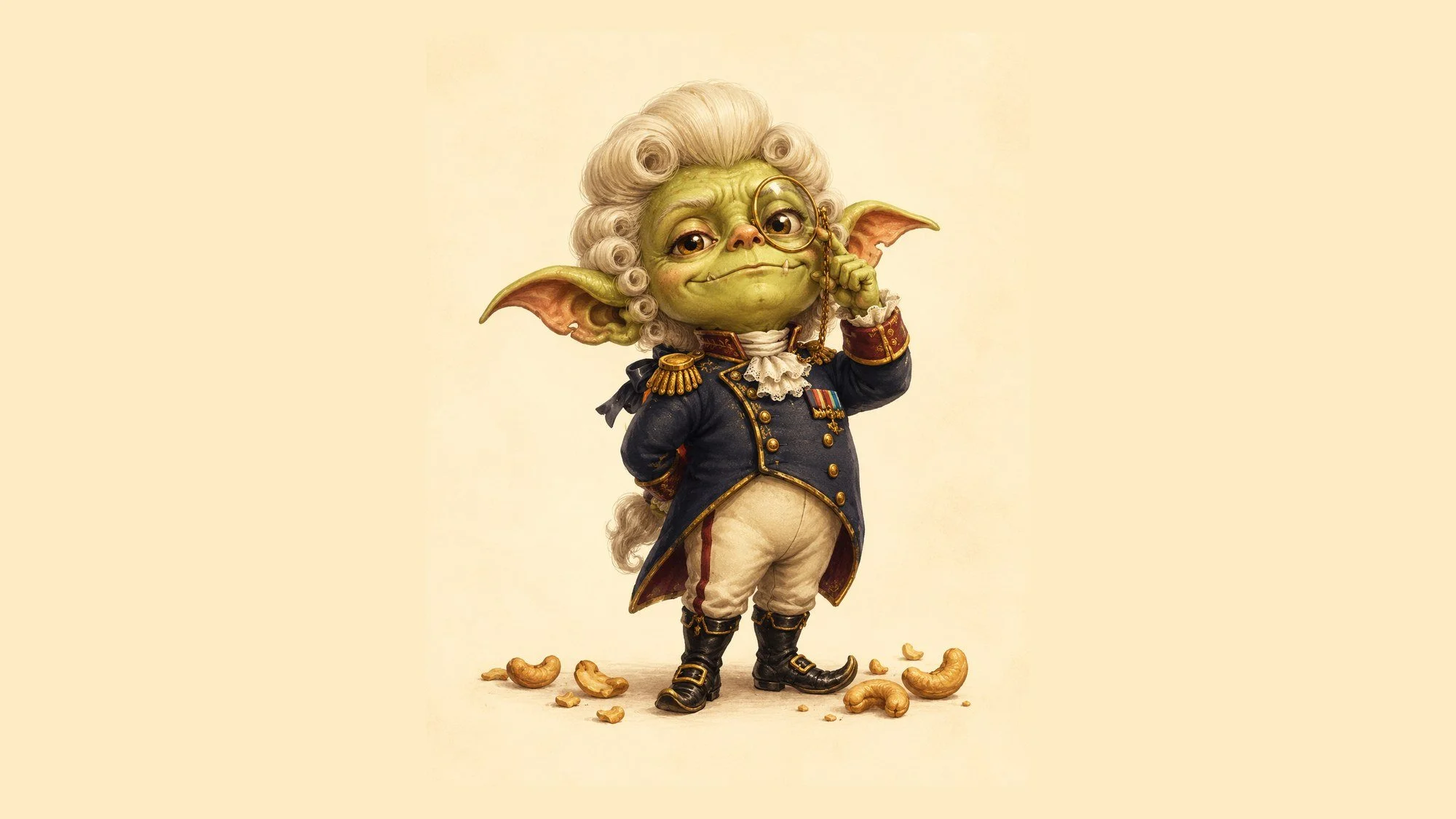
Meet Reginald
Meet Reginald: my powdered-wigged lieutenant gremlin—wildly overconfident, occasionally competent, fiercely loyal, and somehow commissioned. What began as a joke about my own “gremlin mode” eventually taught me something unexpected about grace, belonging, and what it means to serve.
For a long time, I had something I simply called gremlin mode.
Gremlin mode was the part of me that got restless.
It wanted to go somewhere.
Do something.
See what was over the next hill.
Take the longer road because it looked more interesting.
Say yes to the adventure before anyone had finished explaining the risks.
Gremlin mode was not evil. In fact, some of the best experiences of my life probably happened because of it.
Gremlin mode was also responsible for more than a few moments where, in retrospect, I have been forced to ask myself:
What the fuck were you thinking?
The answer, generally, was that I was not thinking.
The gremlin was driving.
Then, not too long ago, I had a revelation.
I do not need to kill the gremlin.
I need the gremlin to serve me.
That changed everything.
Because once I realized gremlin mode was not supposed to rule, I realized he needed a chain of command.
And if he was going to have a chain of command, he needed a name.
So I named him Reginald.
Naturally.
Reginald is now my imaginary lieutenant gremlin.
He wears a military tunic and a powdered aristocratic wig.
Occasionally, there is a monocle.
I did not authorize the monocle.
I have accepted the monocle.
Reginald is refined now.
Or at least Reginald believes himself to be refined.
He has manners.
He has rank.
More importantly, somehow, he has a commission.
He also remains wildly overconfident and not entirely competent.
This is an important distinction.
Reginald is capable of walking into the command tent, adjusting his powdered wig, placing one tiny hand behind his back, and announcing:
“Sir, I have developed a plan.”
This is rarely good news.
The plan may involve a canoe.
It may involve diplomatic relations with people who have not requested diplomatic relations.
It almost certainly involves cashews.
Reginald loves cashews.
I am not entirely sure when cashews became part of the mythology, but they are now considered essential logistical supplies.
Reginald is allowed considerable operational freedom, provided that he remains within certain moral, ethical, and legal constraints.
He may frolic.
He may wander.
He may propose questionable excursions.
He may not sabotage.
This arrangement seems to be working.
Mostly.
Because what I eventually realized is that Reginald represents something real.
He is my restlessness.
My curiosity.
My appetite for adventure.
The part of me that looks at the horizon and thinks:
I wonder what is over there.
He is courage without sufficient briefing.
Confidence without complete intelligence.
Adventure occasionally masquerading as strategy.
For most of my life, I handled that part of myself in one of two ways.
I either let it drive—
or I tried to suppress it.
Neither worked particularly well.
Reginald needed neither exile nor sovereignty.
He needed a commission.
A commission means you have authority, but that authority exists in service to something greater than yourself.
You have responsibility.
You have a role.
You have a commander.
Reginald is not in charge of the army.
Thank God.
But I do not want an army without Reginald either.
I need his curiosity.
I need his willingness to take risks.
I need the part of me that still believes a road can lead somewhere wonderful simply because I have never walked it before.
I need the part that sometimes says, with absolutely irrational confidence:
We could do that.
I simply need him to remember that he serves.
And somewhere in the development of this strange little mythology, Reginald went to war.
Again, this is imaginary.
Mostly.
One day, I asked him a question.
“Reginald, who burned down Moscow?”
He stood proudly in his tunic, powdered wig no doubt perfectly arranged, and answered without hesitation:
“I did.”
I looked at him.
“No, you didn’t.”
Reginald paused.
“That was me.”
The confidence disappeared.
He looked down at the campaign ribbon pinned to his tunic.
Then, quietly, he removed it.
He handed it back to me.
Because he understood.
The victory was not his.
The campaign was not his to claim.
He was not the commander.
And for a moment, there he stood without the ribbon.
My ridiculous little lieutenant.
My gremlin.
I looked at him.
Then I took the ribbon.
And I pinned it back onto his tunic.
“No,” I told him.
“You were there.”
That was the moment the joke grew a heart.
Reginald did not get the ribbon because he commanded the campaign.
He did not get it because he made every decision.
He did not get it because he could claim responsibility for history.
He got it because he had been there.
He walked beside me.
He endured the campaign.
He carried the cashews.
He belonged.
And somewhere along the way, while laughing about this absurd aristocratic lieutenant gremlin with questionable tactical judgment, I encountered a deeply inconvenient realization.
I am Reginald.
More specifically:
I am Jesus’s Reginald.
That realization explained an uncomfortable amount of my life.
I have spent years walking confidently into situations Jesus probably watched with the spiritual equivalent of a hand pressed against his forehead.
“Will.”
“Yes?”
“That is not the direction I suggested.”
“I know.”
“Then why are you going that way?”
“Adventure?”
Long pause.
“Will.”
I have wandered.
I have improvised.
I have marched forward with the confidence of a field marshal while possessing approximately the situational awareness of a golden retriever who has discovered an open gate.
I have made mistakes.
Real ones.
Some choices created consequences I did not want.
Some roads were harder than they needed to be.
And one of the temptations of faith is to look backward and say that because God eventually redeemed something, the mistake must have secretly been the right choice all along.
I do not believe that.
Grace is not God pretending my stupidity was wisdom.
Redemption is not God retroactively calling every bad decision obedience.
Sometimes I chose poorly.
Sometimes I had multiple options and enthusiastically selected the one marked:
THIS ROUTE CONTAINS UNNECESSARY SUFFERING.
And marched forward anyway.
Probably carrying cashews.
But somehow, Jesus came with me.
Not because he approved of every direction.
Because he refused to abandon the traveler.
That is the part of grace I think I am still learning.
There is a difference between being corrected and being discarded.
There is a difference between consequences and rejection.
There is a difference between God saying,
“That was not the move I wanted you to make,”
and God saying,
“You are no longer mine.”
Perhaps that is why I love Reginald.
Because Reginald can be wrong and still belong.
I can take command back from him without destroying him.
I can tell him he did not burn Moscow.
I can correct the record.
I can take the ribbon from his hand.
And then I can pin it back on his tunic.
Because he was there.
And sometimes I wonder whether Christ looks at me in a way I am only beginning to understand.
Not as a perfectly obedient soldier.
Clearly.
Not as the commander.
Absolutely not.
But perhaps as something closer to Reginald.
A strange little lieutenant who has occasionally misunderstood the mission.
Who has wandered beyond the map.
Who has returned from operations with several items nobody remembers issuing.
Who has asked forgiveness.
Who has learned.
Who has failed.
Who has gotten back up.
Who remains astonishingly confident despite an operational history that should probably have humbled him considerably more by now.
And yet—
still commissioned.
Still entrusted with work.
Still invited to walk beside the Commander.
I imagine that someday I may stand before Jesus with an entire career’s worth of questionable field reports.
He will look at me.
I will look at him.
There will be a silence.
“Reginald.”
“Sir.”
“What happened down there?”
“Well, technically—”
“Reginald.”
Another pause.
“Yeah. Okay.”
And perhaps I will look down and notice that somewhere along the journey, my campaign ribbon has come loose.
And perhaps Christ will reach forward.
Straighten it.
Pin it back into place.
Not because I commanded the campaign.
Not because I won every battle.
Not because every decision I made was wise.
But because somehow, through all of it—
I was there.
And more importantly,
so was he.
So yes.
Reginald is my little gremlin lieutenant.
He wears a powdered wig.
Sometimes a monocle.
He is ambitious beyond his competence.
His operational planning requires supervision.
His loyalty is unquestioned.
And somewhere along the way, I realized that I may very well be Jesus’s Reginald.
Which means perhaps there is hope for me yet.
I imagine Christ looking at my crooked ribbon, my battered tunic, and whatever unauthorized equipment I have somehow acquired along the way.
He sighs.
Straightens the ribbon.
And says:
“Come on, Reginald.”
I nod.
“Where are we going?”
Another long pause.
“Just follow me.”
I adjust my powdered wig.
Check the cashews.
And march.
Because apparently—
we still have work to do.
BECOMING THE STANDARDA FitzStandards Blog Essay
There was a long stretch of my life where I moved through the world like a man walking without a map. I had competence, yes. Skill. Talent. Even flashes of brilliance. But without discipline, direction, or legacy, brilliance becomes a candle in the wind — bright for a moment, extinguished just as quickly.
I had the résumé. I had the stories. I had the experience. Twenty-three years in uniform. Aviation. Safety. Leadership. Creativity. But beneath all of it, there lived a truth I refused to look at:
I was surviving on potential, not purpose.
Potential is a flattering prison.
It lets you feel powerful without ever requiring the cost.
Looking back, I can see the pattern clearly.
I drifted — professionally, physically, spiritually.
I let comfort dilute ambition.
I let heartbreak break focus.
I let circumstance dictate direction.
I became a man who could have been more.
And that realization was the beginning of the reckoning.
The Turning Point: Discipline or Decay
At some point, you either set a standard or you sink beneath one.
My life was decorated with achievements, but hollowed by inconsistency. I had no morning rituals. No structured discipline. My body carried the weight of years without accountability. My goals scattered in all directions. My relationships, even the ones that shaped me to my core, existed in a fog of unanchored emotion.
I wasn’t weak — I was unaligned.
And unaligned men eventually break.
So I made a decision:
I would no longer be a man of intentions. I would be a man of standards.
My standards.
FitzStandards.
The Becoming: A Man Reforged
Transformation doesn’t start when your life is perfect.
It starts when you’re sick of your own excuses.
For me, the shift was violent and quiet at the same time. A whisper and a war cry.
I cut out alcohol.
I built morning and evening rituals.
I walked more. Ate cleaner. Measured everything.
I rebuilt my wardrobe.
I rebuilt my house into a temple of discipline.
I rebuilt my body, step by step, pound by pound.
I rebuilt my identity — not to impress, but to ascend.
I created FitzStandards not as a brand, but as a covenant.
A vow to myself: Become the man your younger self prayed you would grow into — and the man your future son will thank you for becoming.
This isn’t about aesthetic success, though the aesthetics will come.
This is about internal sovereignty.
About a spine that does not bend.
About a heart that does not drift.
About a life that speaks in actions, not promises.
Why The Standard Matters
In a world drowning in softness, distraction, and men without direction, The Standard is not a luxury — it is a necessity.
The Standard is the antidote to chaos.
The Standard is the compass when everything else is noise.
The Standard is the difference between a man who is carried by life…
and a man who carries life on his shoulders.
A standard:
Removes confusion.
Creates clarity.
Separates the men who talk from the men who build.
Protects your future from your impulses.
Aligns your body, your mind, and your spirit into a single trajectory.
Every man wants greatness.
Only a few build the scaffolding for it.
The Standard is that scaffolding.
How Others Should Live The Standard
FitzStandards is not about perfection.
It’s about precision.
It’s not about being better than others.
It’s about being better than your former self.
To live the Standard:
Establish a Code.
Write the rules that govern your life and obey them without negotiation.Maintain the Body.
Your physique is not vanity — it is a man’s first proof of discipline.Guard the Mind.
The world is full of noise. Standards filter the noise and protect your focus.Forge Emotional Mastery.
Not numbness — mastery. Strength with depth.Build Legacy Daily.
Legacy is not a grand gesture; it is the accumulation of small, consistent choices.Honor the Covenant.
Do what you say you will do.
Even when no one is watching.
Especially when no one is watching.
The Standard is not a trend.
It is not a “self-improvement phase.”
It is a way of life — the kind of life that forces the world to take you seriously.
I Am Becoming FitzStandards
I am not perfect.
I am not finished.
I am becoming.
Every walk.
Every meal.
Every step toward 10–12% body fat.
Every chapter written.
Every podcast recorded.
Every book released.
Every disciplined choice.
Brick by brick, breath by breath, rep by rep —
I am becoming the man I should have been all along.
This isn’t motivation.
This is metamorphosis.
And if there’s one thing I’ve learned, it’s this:
A man with a standard becomes a man with a legacy.
A man without a standard becomes a warning.
Choose wisely.